

The main difference in hypomania vs mania is severity. Both involve a high or irritable mood with more energy, less sleep, and racing thoughts, but mania lasts at least a week and seriously disrupts work, relationships, or safety, while hypomania lasts at least four days and stays mild enough that daily life mostly keeps running. That distinction decides whether a diagnosis is bipolar I or bipolar II, so it shapes treatment for years. The question affects many people: according to the National Institute of Mental Health, about 4.4% of U.S. adults experience bipolar disorder at some point, and 82.9% of adults with a past-year diagnosis have serious impairment. Below you will find how each state is defined, how to tell them apart in real life, and what to do when you notice the signs.
What Is Mania and Hypomania?
Mania and hypomania are distinct periods of abnormally elevated, expansive, or irritable mood combined with a persistent increase in energy or activity. They share the same symptom list and differ in duration, severity, and whether psychosis or hospitalization is involved.
What Counts as a Manic Episode?
A manic episode lasts at least seven days, most of the day, nearly every day, or any length of time if hospitalization is needed. It causes marked problems at work, at school, or in relationships, may include psychotic symptoms such as delusions, and sometimes requires a hospital stay to keep the person safe.
What Counts as a Hypomanic Episode?
A hypomanic episode lasts at least four consecutive days. The change is clear enough that family, friends, or coworkers notice it, yet it does not cause marked impairment, does not require hospitalization, and never includes psychosis. If psychosis appears, the episode counts as mania by definition.

Which Symptoms Do Mania and Hypomania Share?
Mania and hypomania require at least three of these symptoms (four if the mood is only irritable):
- Inflated self-esteem or grandiose ideas
- Less need for sleep, such as feeling rested after three hours
- Talking more than usual or feeling pressure to keep talking
- Racing thoughts or jumping quickly between ideas
- Distractibility, with attention pulled by small, unrelated things
- More goal-directed activity or physical restlessness
- Risky choices, such as spending sprees, reckless driving, or impulsive sexual decisions
What Is the Difference Between Mania and Hypomania?
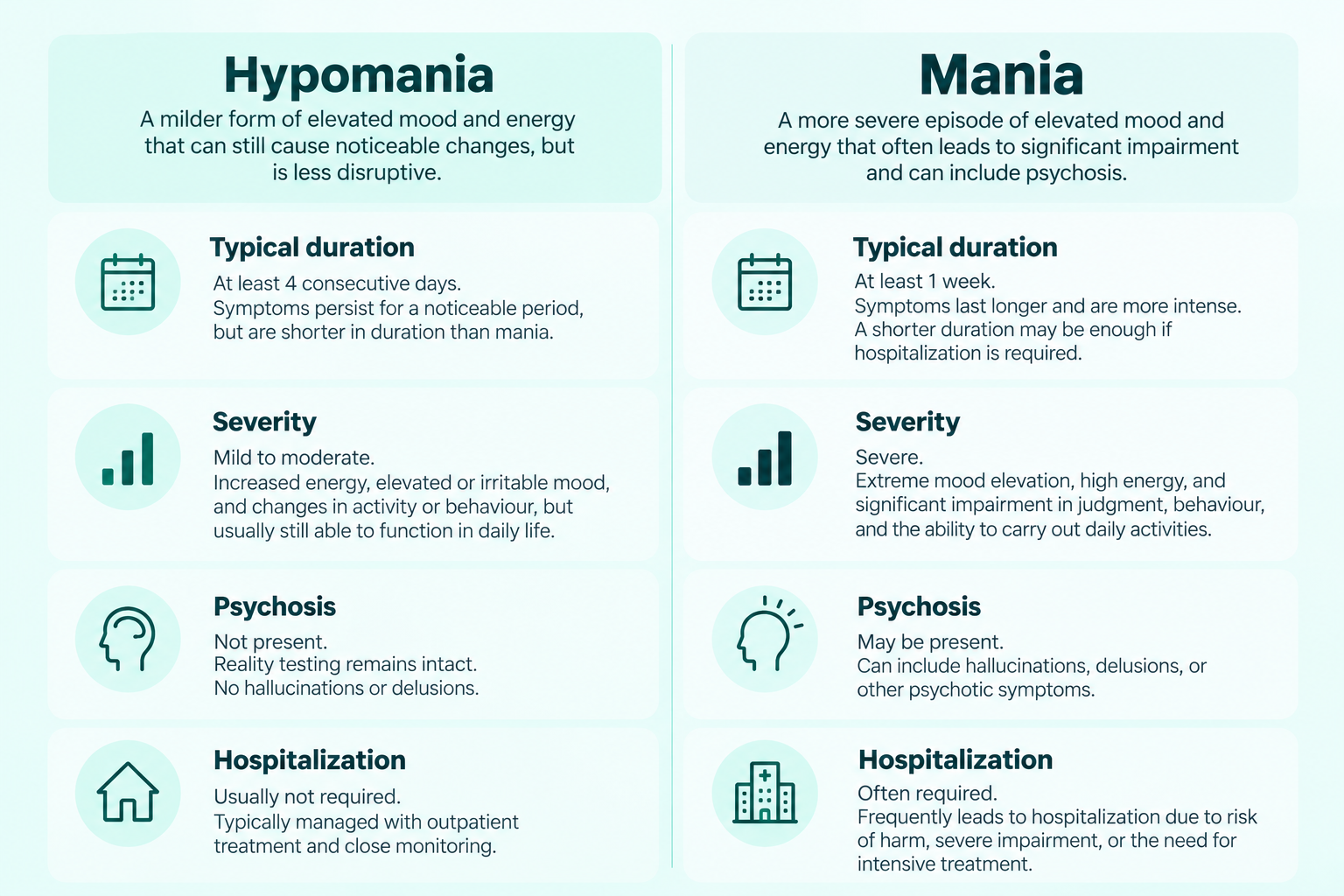
The difference between mania and hypomania comes down to four markers: how long the episode lasts, how much it disrupts life, whether psychosis appears, and whether hospitalization is needed. This table compares hypomania vs mania side by side.
| Feature | Hypomania | Mania |
|---|---|---|
| Minimum duration | 4 consecutive days | 7 days, or any length if hospitalized |
| Impact on functioning | Noticeable change, no marked impairment | Marked impairment at work, school, or home |
| Psychosis | Never | Possible (delusions, hallucinations) |
| Hospitalization | Not required | Often needed for safety |
| How it may feel | Productive, confident, “on a roll” | Out of control, or invincible without insight |
| Related diagnosis | Bipolar II (with depression), cyclothymia | Bipolar I |
How Long Does Each Episode Last?
Duration is the most concrete rule in hypomania vs mania. By current DSM-5 rules, hypomania needs at least four days and mania at least seven. These cutoffs are debated. A February 2025 review in Psychiatric Times (Osser) describes an international expert task force in which the most common proposed minimum was two days for both states. Shorter episodes with enough symptoms can still point to the bipolar spectrum and change treatment, especially decisions about antidepressants.
How Much Does Each One Disrupt Daily Life?
Hypomania often looks like a better-than-usual version of the person: more ideas, more plans, less sleep, and more charm. Mania goes further. A person in a manic episode may quit a job on impulse, max out credit cards, stop sleeping for days, or put themselves in danger, and others can no longer redirect them.
Can Hypomania Include Psychosis?
No, and psychosis is the sharpest dividing line between hypomania vs mania. Hallucinations, delusions, or beliefs that are clearly out of touch with reality move an episode into mania, even if it lasted fewer than seven days. Grandiose plans during hypomania stay possible, if ambitious, while manic grandiosity can become fixed false beliefs, such as having a special mission or secret powers.
How Do Mania vs Hypomania Shape a Bipolar Diagnosis?
The highest state a person has ever reached sets the diagnosis. One full manic episode is enough for bipolar I, while hypomania paired with major depression points to bipolar II.
Bipolar I, Bipolar II, and Cyclothymia
- Bipolar I: at least one manic episode; depressive episodes are common but not required.
- Bipolar II: at least one hypomanic episode and at least one major depressive episode, with no history of mania.
- Cyclothymic disorder: at least two years (one year in children and teens) of frequent hypomanic and depressive symptoms that never meet full episode criteria. Learn more about cyclothymic disorder treatment.
Bipolar II is not a “milder” illness overall. People with bipolar II often spend more time depressed than people with bipolar I, and the depression drives much of the disability.
Can Hypomania Turn Into Mania?
Yes. Hypomania can escalate into mania within days, especially with sleep loss, substance use, stress, or an antidepressant taken without a mood stabilizer. Once a person has a full manic episode, the diagnosis changes to bipolar I, even if earlier episodes were all hypomanic.
What Does Hypomania vs Mania Look Like in Real Life?
The same person can show either state, so concrete examples help. These two scenarios show how hypomania vs mania plays out in one life.
Example of a Hypomanic Episode
For five days, a 34-year-old accountant sleeps five hours a night and feels fresh. She finishes a backlog of reports, signs up for two online courses, talks faster in meetings, and texts friends late at night with new business ideas. Her partner notices she seems “revved up,” but she keeps her job, pays her bills, and stays safe. This pattern fits hypomania.
Example of a Manic Episode
The same accountant goes eight days with almost no sleep. She resigns by email to launch a company, spends $15,000 on equipment, argues with coworkers who question her plan, and becomes convinced investors are secretly competing for her. Her family brings her to an emergency room. Marked impairment and a delusional belief make this mania.
Can Antidepressants Cause Activation of Mania or Hypomania?
Yes. Antidepressants can trigger a manic or hypomanic episode in people with an underlying bipolar tendency, which is why the risk appears on every antidepressant label. The FDA prescribing information for sertraline (revised 2021) warns that treating a depressive episode with an antidepressant may precipitate a mixed or manic episode and tells prescribers to screen for any personal or family history of bipolar disorder, mania, or hypomania before starting.
Who Faces a Higher Risk?
Activation of mania or hypomania is more likely if you have:
- A prior diagnosis of bipolar disorder, especially without a mood stabilizer
- A parent or sibling with bipolar disorder
- Depression that started in the teens or early twenties
- Past episodes of feeling unusually energized after starting an antidepressant
- Depression with mixed features, such as racing thoughts or agitation alongside low mood
What Should You Do If an Antidepressant Seems to Trigger It?
A sudden lift in energy and a drop in sleep need within days or weeks of starting an antidepressant deserve a same-day call to your prescriber. Do not stop the medication abruptly without guidance, since your clinician may lower the dose, add a mood stabilizer, or switch treatment.
How Are Mania and Hypomania Treated?
The treatment gap in hypomania vs mania is wide: mania usually needs urgent, intensive care, while hypomania is often managed in outpatient care with medication changes and close monitoring.
Treating a Manic Episode
Treatment for acute mania typically includes a mood stabilizer such as lithium or valproate, an antipsychotic, or both. Antidepressants are usually stopped. If the person is in danger, cannot care for themselves, or has psychotic symptoms, a short hospital stay keeps them safe until the medication takes effect.
Treating Hypomania
Hypomania often responds to adjusting the current regimen: reducing or stopping an antidepressant, starting or raising a mood stabilizer, and protecting sleep. Because hypomania can feel good, many people delay reporting it, but early treatment can prevent escalation to mania or a crash into depression. Ongoing bipolar disorder treatment combines medication with therapy approaches that build steady routines.
Common Mistakes When Comparing Hypomania vs Mania
Most misreadings happen because hypomania feels like a good stretch rather than a symptom.
- Calling hypomania a “good week.” Treating it as normal energy means it never gets reported, and bipolar II is often misdiagnosed as depression for years.
- Reporting only depressive episodes. Psychiatrists cannot see past highs unless you or your family describe them.
- Ignoring irritability. Mania and hypomania can show up as anger and impatience instead of euphoria, a pattern covered in this guide to bipolar rage and its triggers.
- Overlooking sleep. Needing much less sleep without feeling tired is one of the earliest and most reliable warning signs.
- Missing it in teens. Adolescents may show hypomania as risk-taking or irritability, so knowing the early signs of bipolar disorder in teens helps parents act sooner.
How to Track Mood Changes Before Your Appointment
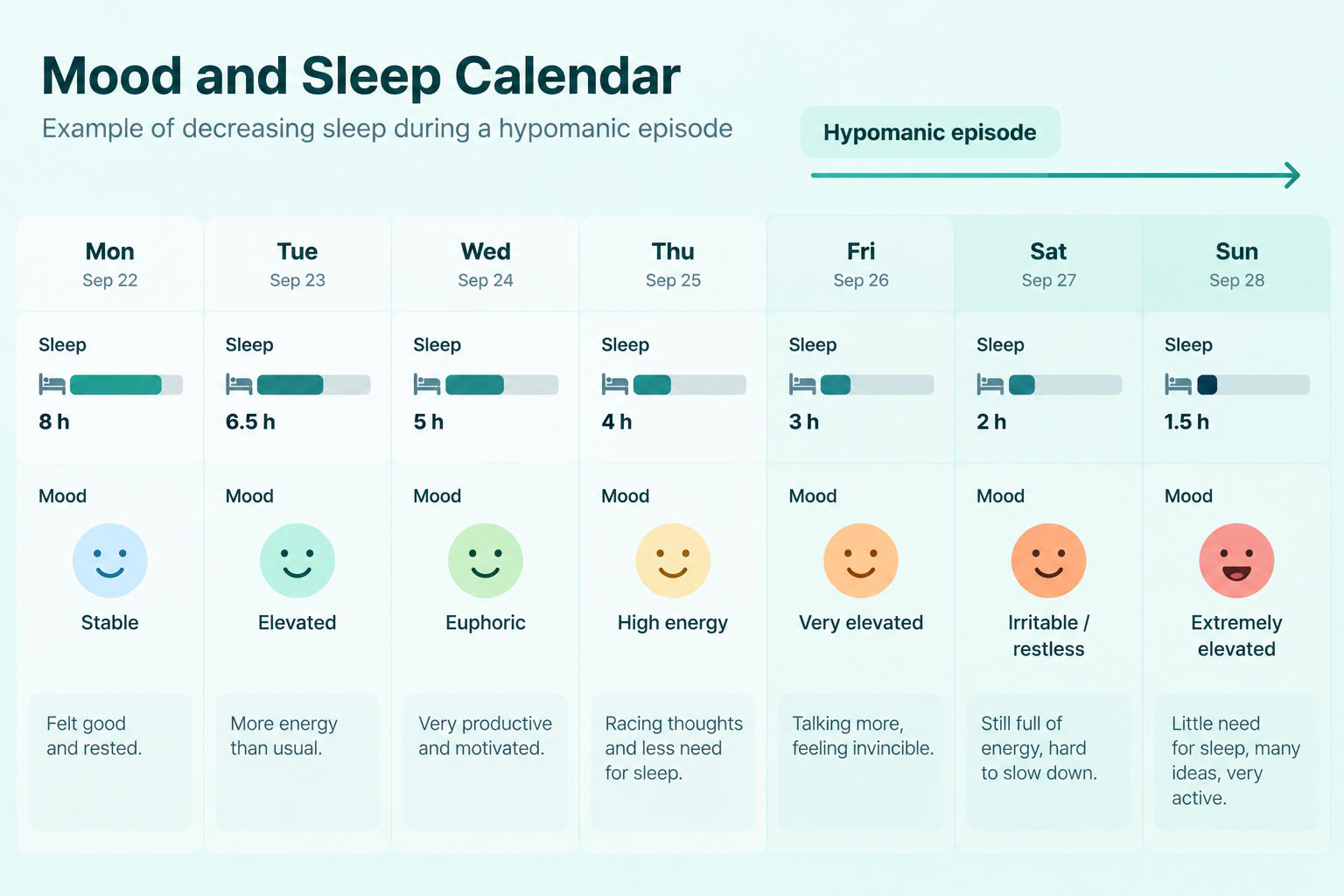
A mood record turns vague memories into evidence a psychiatrist can use to settle the hypomania vs mania question. Start tracking as soon as you notice a change:
- Log sleep hours every night, since a drop of two or more hours without fatigue is an early flag.
- Rate mood and energy daily on a simple scale from -5 to +5, which makes highs and lows easy to spot over weeks.
- Note spending, new projects, and risky choices, because these behaviors reveal intensity better than mood words.
- Ask a partner, friend, or family member what they noticed, since others often see hypomania before you do.
- Record any medication, dose change, or substance used in the same period, so links to triggers stand out.
As a simple rule, if the high lasts four days or more and others notice it, book an evaluation soon. If it involves no sleep, dangerous decisions, or beliefs that others find impossible, treat it as urgent and seek same-day care.
Sorting out hypomania vs mania early can prevent a hospitalization, a lost job, or a misdiagnosis that keeps you on the wrong medication. Good Health Psychiatric Services offers same-day or next-day evaluations with psychiatrists and psychiatric nurse practitioners who assess mood history, review current medications for activation risk, and build a treatment plan through ongoing psychiatric medication management. Visits are available in Downtown Brooklyn or by video across NY, NJ, PA, FL, and CT, in nine languages, for adults, adolescents, and children.
Schedule a ConsultationFrequently Asked Questions
Can I have hypomania without having bipolar disorder?
Sometimes. Hypomania-like states can follow antidepressant use, stimulant or steroid medications, thyroid overactivity, or heavy substance use. A psychiatrist checks whether symptoms persist beyond the effect of a substance or medication. Repeated hypomanic episodes alongside depression usually point to bipolar II.
How do I know if I’m just happy or hypomanic?
Happiness usually has a reason and leaves sleep, judgment, and speech intact. Hypomania lasts days, often has no clear trigger, and comes with reduced sleep need, faster speech, racing thoughts, and choices that others find out of character. If friends ask whether you are okay while you feel great, take that as a signal.
Can I go to work during a hypomanic episode?
Many people can, since hypomania by definition does not cause marked impairment. Still, watch for impulsive emails, overcommitting, or conflicts with coworkers, and limit big decisions until the episode settles. If performance or judgment start slipping, the episode may be escalating and needs prompt attention from your prescriber.
Should I go to the ER for mania?
Go to the ER or call 911 if mania includes thoughts of harming yourself or others, delusions or hallucinations, days without sleep, or behavior that puts you in danger. For a first or worsening high without these features, a same-day psychiatric appointment is usually the right step.
Can caffeine or lack of sleep trigger my hypomania?
Yes, sleep loss is one of the most common triggers for both states, and large amounts of caffeine or energy drinks can worsen sleep and agitation. Overnight travel, shift work, and newborn care are frequent culprits. Keeping a fixed sleep and wake time is one of the most protective habits in bipolar disorder.
Will I need medication for hypomania?
Most people with recurring hypomania benefit from a mood stabilizer or a related medication, especially when depressive episodes also occur. The choice depends on your history, side effect concerns, and plans such as pregnancy. Therapy, routine, and sleep protection support medication rather than replace it.
Can children have mania or hypomania?
Yes, though it is less common before the teen years and harder to recognize. In children, a high mood can look like extreme silliness, grandiose claims, rage, or very little sleep that lasts for days. Because ADHD and other conditions can look similar, a child and adolescent psychiatrist should complete the evaluation.