

The key to mania vs psychosis is that mania is a mood state, while psychosis is a break from reality. Mania means days of extreme energy, little sleep, racing thoughts, and risky behavior. Psychosis means hallucinations, delusions, or disorganized thinking. The two can occur separately or together, and that overlap is why they are so often confused. Psychosis is not rare: according to NAMI (2017), about 3 in 100 people experience it at some point in life, and roughly 100,000 young people in the U.S. have a first episode each year. Below you will learn how to tell the two apart, which conditions cause each, and when symptoms need emergency care.
What Is Psychosis and Mania?
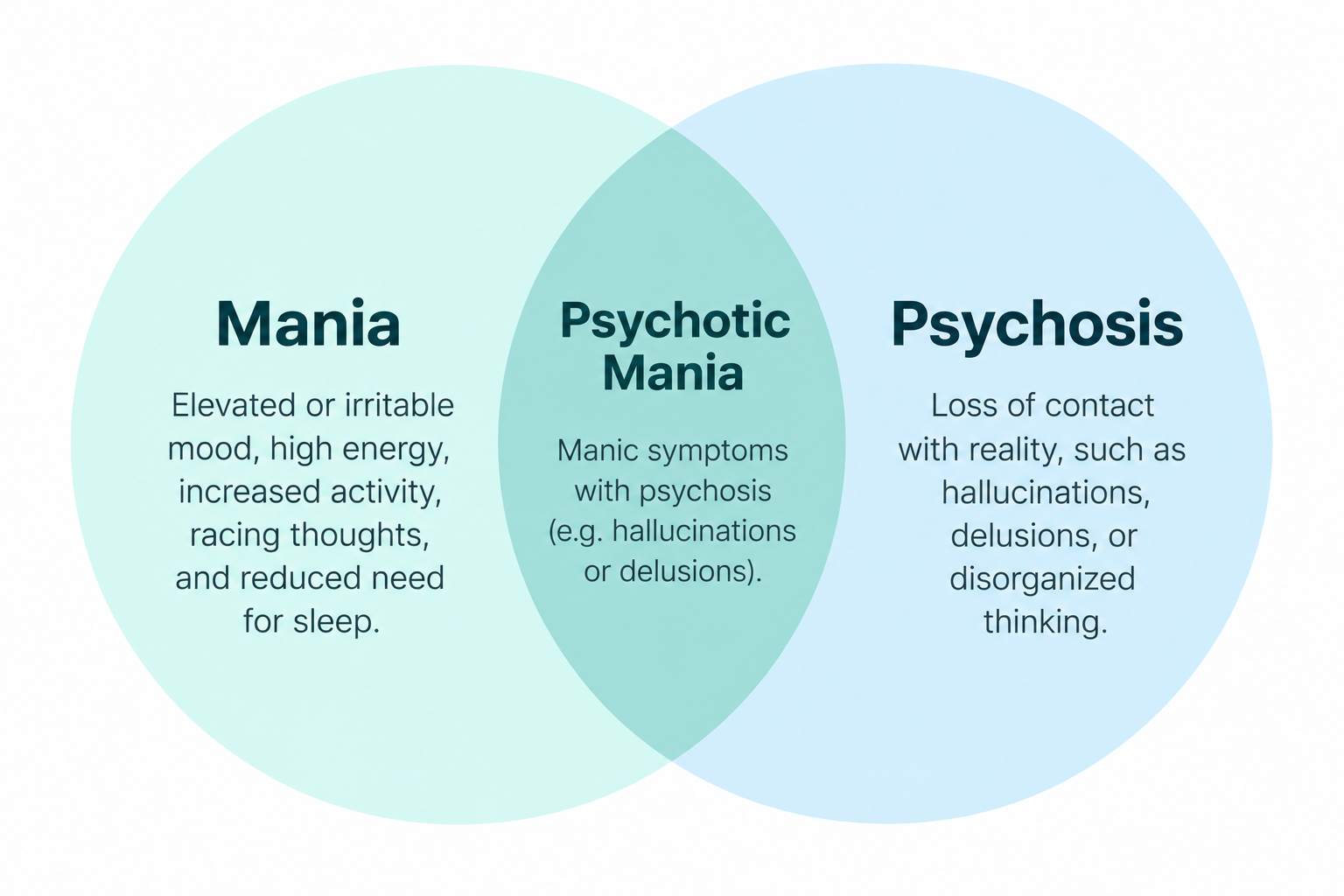
Mania and psychosis describe different things. Mania is a type of mood episode, while psychosis is a group of symptoms that can appear in many conditions, including mania itself.
What Mania Looks Like
Mania is a period of at least a week of abnormally high, expansive, or irritable mood with increased energy. Typical signs include:
- Sleeping very little without feeling tired
- Talking fast and jumping between ideas
- Grandiose confidence and big, unrealistic plans
- Impulsive spending, sex, or risk-taking
- Serious problems at work, at home, or with safety
What Psychosis Looks Like
Psychosis means a person loses touch with what is real. The core symptoms are:
- Hallucinations: hearing, seeing, or feeling things others do not
- Delusions: fixed false beliefs, such as being watched, chosen, or controlled
- Disorganized thinking: speech that is hard to follow or jumps without logic
- Changes in behavior: withdrawal, confusion, or actions that do not fit the situation
Is Mania the Same as Psychosis?
No. Mania is not psychosis, but severe mania can include psychosis. Asking “is mania psychosis” is a bit like asking whether a fever is pneumonia: one can come with the other, yet each can happen alone.
When Mania Includes Psychosis
Psychotic features are common in bipolar I disorder. In a 2022 study of 162 adults with bipolar I disorder in the International Journal of Bipolar Disorders, about 59% had experienced psychotic features at some point. The National Institute of Mental Health (2025) explains that these symptoms usually match the extreme mood, so a person in a manic episode may falsely believe they are famous or have special powers.
When Psychosis Happens Without Mania
Psychosis also appears with no manic mood at all. It occurs in schizophrenia, severe depression, drug intoxication or withdrawal, some medical illnesses, and the weeks after childbirth. In these cases, the person may be flat, withdrawn, or frightened rather than energized.
What Is the Difference Between Mania and Psychosis?
The difference between mania and psychosis lies in what is affected: mania changes mood, energy, and activity, while psychosis changes how a person perceives and interprets reality. This table compares mania vs psychosis side by side.
| Feature | Mania | Psychosis |
|---|---|---|
| What it is | A mood episode | A set of symptoms |
| Core change | Extreme energy, mood, and activity | Loss of contact with reality |
| Main signs | Little sleep, racing thoughts, grandiosity, risky acts | Hallucinations, delusions, disorganized thinking |
| Typical mood | Euphoric or irritable | Can be any mood, often fearful or flat |
| Common causes | Bipolar I disorder, antidepressant or steroid triggers | Schizophrenia, substances, mania, severe depression, medical illness |
| Can occur with the other | Yes, as mania with psychotic features | Yes, during mania or depression |
Mood-Congruent vs Mood-Incongruent Psychosis
When psychosis appears during mania, psychiatrists ask whether it fits the mood. Mood-congruent beliefs match the high, such as believing you are a genius or on a divine mission. Mood-incongruent symptoms do not fit, such as hearing voices accusing you or believing your thoughts are being broadcast. This distinction matters: in the same 2022 study, people with mood-incongruent features had attempted suicide far more often (62.8%) than people with mood-congruent features (34.6%).
A Quick Example of Each
A side-by-side example makes psychosis vs mania easier to see. Picture two people who both stopped sleeping. The first speaks fast, buys three cars, and announces she will be president, and her belief grows from her elated mood: that is mania with psychotic features. The second is quiet and fearful, hears neighbors discussing him through the walls, and shows no change in energy: that points to a primary psychotic disorder rather than mania.
Which Conditions Cause Mania and Psychosis?
Several diagnoses involve mania and psychosis, and in the mania vs psychosis question, timing is the main clue that separates them.
Bipolar I, Schizophrenia, and Schizoaffective Disorder
- Bipolar I with psychotic features: psychosis appears only during manic or depressive episodes and clears as the mood returns to baseline.
- Schizophrenia: psychosis lasts six months or longer, mood episodes are absent or brief, and functioning declines. Learn more about schizophrenia and schizoaffective disorder.
- Schizoaffective disorder: mood episodes occur, but psychosis also continues for at least two weeks without any mood episode.
People with bipolar disorder and psychosis are sometimes misdiagnosed with schizophrenia, a risk the NIMH highlights. A detailed history of mood and sleep across past episodes is the best protection against that error. The confusion with “split personality” is another common myth, covered in this guide to bipolar vs split personality.
Substance and Medical Causes
Stimulants, cannabis, hallucinogens, alcohol withdrawal, and steroid medications can trigger mania-like states, psychosis, or both. Thyroid disease, brain injury, infections, and some seizure disorders can do the same. Doctors usually check drug use, run blood tests, and sometimes order brain imaging during a first episode.

When Are Mania and Psychosis an Emergency?
Mania with psychosis, or psychosis of any kind that appears suddenly, usually needs same-day professional care and sometimes emergency care.
Signs That Need Immediate Help
Whatever the mania vs psychosis answer turns out to be, call 911 or go to the nearest emergency room if you notice:
- Talk of suicide or harming others
- Command hallucinations telling the person to act
- No sleep for several nights in a row
- Confusion, inability to eat or drink, or unsafe behavior
- Sudden psychosis after drug use, a head injury, or childbirth
How Families Can Help in the Moment
- Stay calm and speak in short, simple sentences, since arguing with delusions usually increases fear.
- Remove car keys, credit cards, and weapons if safety is at risk.
- Write down when symptoms started, sleep patterns, medications, and any substance use, because this timeline guides diagnosis.
- Call the 988 Suicide & Crisis Lifeline or 911 if risk is high, or arrange an urgent psychiatric visit if the person is safe.
How Are Mania and Psychosis Treated?
Treatment targets the underlying condition, so sorting out mania vs psychosis correctly comes first.
Treating Mania With Psychosis
Psychotic mania is usually treated with an antipsychotic, often combined with a mood stabilizer such as lithium or valproate. Antidepressants are typically stopped. Psychotic symptoms often fade as the mood stabilizes, and long-term care focuses on preventing the next episode through bipolar disorder treatment.
Treating Psychosis Without Mania
Primary psychotic disorders are treated with antipsychotic medication, therapy, family education, and support for school or work. Early treatment after a first episode is linked to better long-term outcomes, which is why specialized psychotic disorder treatment matters as soon as symptoms appear.
Telling mania vs psychosis apart takes a careful history, and the right answer changes which medication works. Good Health Psychiatric Services offers same-day or next-day evaluations with psychiatrists and psychiatric nurse practitioners who review mood patterns, substance use, and medical factors, then build a treatment plan with ongoing medication follow-up. Visits are available in Downtown Brooklyn or by video across NY, NJ, PA, FL, and CT, in nine languages, for adults, adolescents, and children.
Schedule a ConsultationFrequently Asked Questions
Can I have psychosis without bipolar disorder?
Yes. Psychosis occurs in schizophrenia, severe depression, substance use, postpartum illness, and several medical conditions. Bipolar disorder is only one possible cause. A psychiatric evaluation looks at how long symptoms last, whether mood changes come with them, and what substances or medications were involved.
Can I recover fully from psychotic mania?
Many people do. Psychotic symptoms during mania often resolve within days to weeks once treatment starts and mood stabilizes. Staying on maintenance treatment, protecting sleep, and avoiding drugs and alcohol lower the chance that psychosis returns with the next episode.
How do I know if my loved one is manic or psychotic?
Look at energy and mood first. A manic person is usually fast, talkative, and sleeping little, while a person with psychosis alone may be withdrawn, suspicious, or confused. Many people show both. Write down what you observe and share it with a psychiatrist, since your account often shapes the diagnosis.
Can cannabis cause mania and psychosis?
Yes. Heavy cannabis use, especially high-potency products, can trigger psychosis and may worsen mania in people with bipolar disorder. Young people and those with a family history of psychosis face the highest risk. Stopping use is a key part of treatment.
Is it psychosis if I believe I have special powers during a high?
It can be. If the belief is fixed and others cannot talk you out of it, it is a grandiose delusion, which means the mania includes psychotic features. Confident but realistic plans do not count. Either way, a belief like this during a mood high deserves a prompt evaluation.
Does psychotic mania mean I have schizophrenia?
No. Psychosis during mania is common in bipolar I disorder and does not mean schizophrenia. The difference is timing: in bipolar disorder, psychosis appears with mood episodes and clears as they resolve, while schizophrenia involves ongoing psychosis without a matching mood episode.
Can hypomania include psychosis?
No. By definition, hypomania never includes psychosis. If hallucinations or delusions appear during a mood high, the episode is classified as mania, even if it lasted fewer than seven days. That shift also changes the diagnosis from bipolar II to bipolar I, which affects long-term treatment choices.