

According to StatPearls, NCBI Bookshelf, March 2024, the prevalence of narcissistic personality disorder (NPD) in U.S. community samples has been estimated at anywhere from 0 to 6.2 percent. That wide range hints at a problem: narcissism does not always look the way we expect. Some people are loud and self-assured. Others are quiet, anxious, and easily hurt, and their narcissistic traits go unnoticed for years.
If you have ever wondered why someone seems both superior and fragile, or why a “shy” person can be so sensitive to criticism, you are in the right place. Covert vs overt narcissism is a comparison of two ways narcissistic traits show up: overt narcissism is outwardly confident, attention-seeking, and entitled, while covert narcissism is hidden behind shyness, sensitivity, and self-doubt. For example, one person brags about achievements, while another sulks for days after a small slight. This guide explains how they differ, what they share, and how to look after your own mental health.
What Is the Difference Between Covert vs Overt Narcissism?
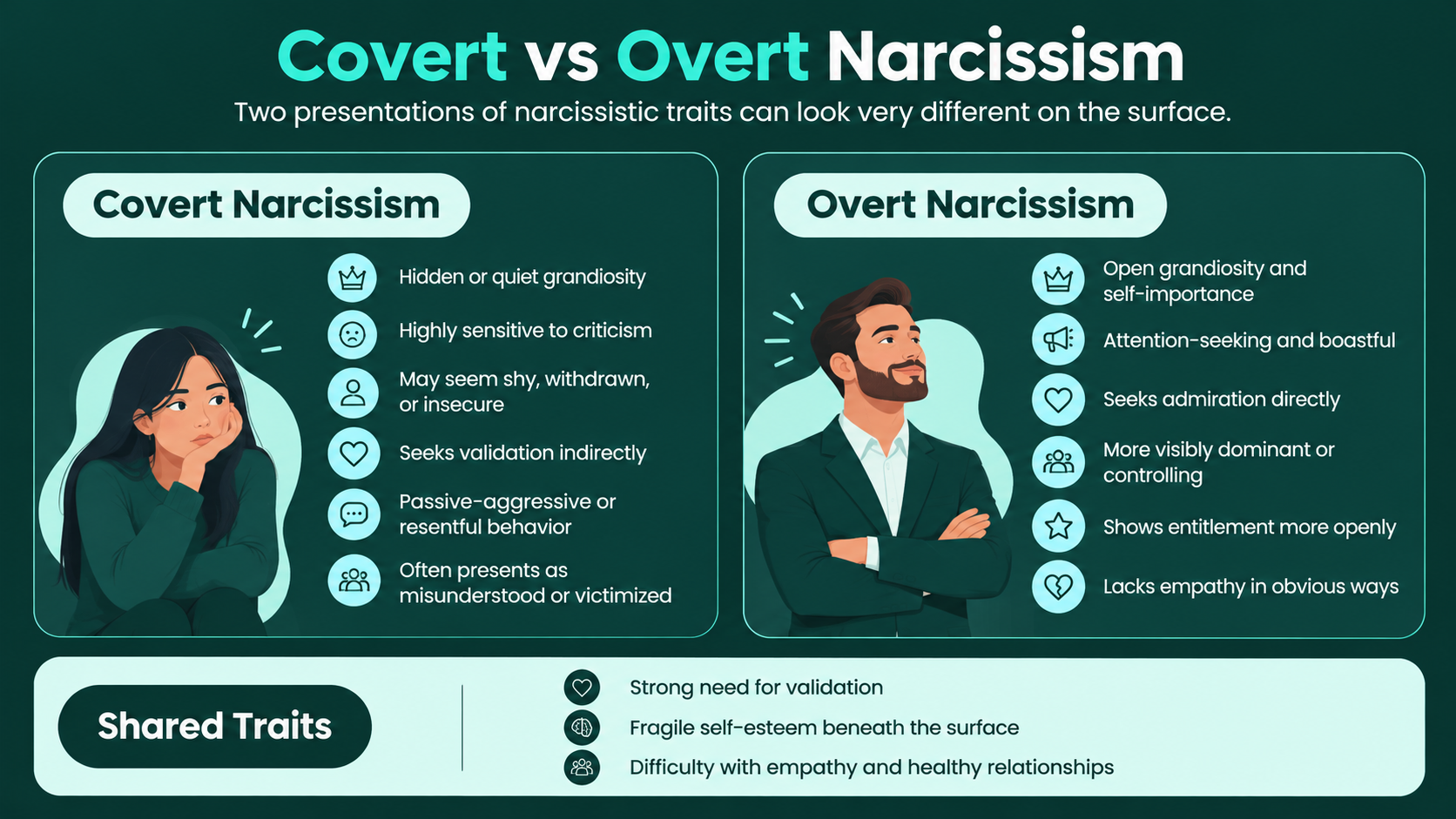
The main difference is visibility: overt narcissism is on display, while covert narcissism is concealed behind a modest or withdrawn surface. Researchers often use the terms “grandiose” for overt and “vulnerable” for covert. Both involve a fragile sense of self-worth and a strong need for validation, even though the outward style is very different.
It helps to know that “covert narcissism” is not a separate diagnosis. The diagnostic manual lists a single condition, narcissistic personality disorder, and clinicians describe subtypes to capture variety. Only a trained professional can evaluate whether traits reach the level of a disorder.
Is It Narcissism vs Covert Narcissism, or the Same Thing?
Covert narcissism is a type of narcissism, not its opposite. When people search for “narcissism vs covert narcissism,” they usually mean the classic, showy image of narcissism compared with the hidden version. Both share core features, such as sensitivity to criticism and difficulty with empathy, but they express them differently.

What Does Overt vs Covert Narcissism Look Like in Real Life?
Overt vs covert narcissism looks different on the surface but often feels similar underneath: a deep need to be seen as special, paired with fear of being exposed as inadequate. The table below summarizes common patterns.
| Overt (Grandiose) | Covert (Vulnerable) | |
|---|---|---|
| Outward style | Confident, dominant, charming | Shy, reserved, self-effacing |
| Reaction to criticism | Anger, dismissal, counterattack | Withdrawal, sulking, deep hurt |
| Self-image | Superior, entitled | Misunderstood, unappreciated |
| In relationships | Demands admiration | Seeks reassurance, then resents needing it |
| Common emotions | Pride, irritation | Shame, envy, anxiety |
Understanding covert vs overt narcissism also explains why one person can seem to switch styles. Someone boastful at work may turn withdrawn and hurt at home. Stress, context, and who is watching can all change which side shows.
What Are Examples of Overt Narcissism?
- Dominating conversations and expecting special treatment
- Exaggerating achievements or talents
- Reacting with contempt when challenged
What Are Examples of Covert Narcissism?
- Playing the victim or feeling chronically unappreciated
- Passive-aggressive comments instead of direct conflict
- Hypersensitivity to slights, followed by silence or withdrawal
How Is Covert Narcissism vs Narcissism in General Different for Others?
People around a covert type often feel confused rather than overpowered. The behavior can look like insecurity, so you may feel guilty for setting limits. With the overt type, the entitlement is more obvious, but the emotional toll can be just as heavy.
How Does Covert Narcissism vs Overt Narcissism Affect Mental Health?
Covert narcissism is more strongly linked to distress than overt narcissism, according to personality research. A study in the Journal of Personality Disorders found that vulnerable narcissism correlated with neuroticism, anxiety, insecure attachment, and reduced well-being, while grandiose narcissism was not correlated with most forms of psychopathology (Kaufman and colleagues, 2018, two samples of 273 and 388 adults).
That does not mean overt narcissism is harmless. Those findings come from online community samples, not clinical patients, and the people around an overt narcissist often bear the cost. Here is a statement you can quote on its own: covert narcissism often hides behind symptoms of anxiety and depression, which is why it is frequently missed.
If you recognize yourself in the covert pattern, you may also notice anxiety, low mood, or a harsh inner critic. These are treatable. You can read more about depression treatment or about narcissistic personality disorder treatment at Good Health Psych.
How Can I Tell Covert Narcissism vs Overt Narcissism in Someone?
You cannot diagnose from the outside, but you can notice patterns in how someone handles criticism, empathy, and attention. These steps can help you sort through what you see:
- Watch the reaction to criticism. Anger and contempt lean overt. Withdrawal, sulking, and long-lasting hurt lean covert.
- Look at the self-story. Does the person see themselves as superior or as uniquely misunderstood and wronged?
- Notice how they ask for attention. Direct bragging is overt. Fishing for sympathy or reassurance is often covert.
- Check the pattern over time. One bad week is not a trait. Look for repeated behavior across settings.
- Consider other explanations. Social anxiety, depression, trauma, and autism can look similar from the outside.
What Risks and Limitations Should I Keep in Mind?
Online labels are easy to misuse, and a wrong label can hurt a relationship or your own self-image. A few honest considerations:
- Shyness is not narcissism. Many quiet, sensitive people have no narcissistic traits at all. Social anxiety and covert narcissism can look alike but have different roots.
- Context shapes behavior. Covert vs overt narcissism is not a fixed label: stress, culture, and relationships can change how traits appear, so avoid treating one snapshot as the whole story.
- People are not one type. Many show both styles at different times, depending on stress and who they are with.
- Do not label yourself harshly. If you worry about your own traits, curiosity is more useful than self-attack.
- Do not diagnose a partner or parent. A label can inflame conflict and may distract from the real issue, which is how the behavior affects you.
Conclusion
Covert and overt narcissism are two faces of the same core struggle: a fragile sense of self protected by very different outward styles. One shows up as confidence, the other as sensitivity, and both can leave people feeling lonely and misunderstood. Knowing the difference in covert vs overt narcissism helps you respond with clarity instead of confusion. If any of this sounds familiar, a professional evaluation can separate narcissistic traits from anxiety, depression, or trauma and point you toward support.
Schedule an appointment with Good Health Psych and talk with a compassionate provider about what you are experiencing, in person or by telehealth.
Schedule a ConsultationFrequently Asked Questions
What is the difference in covert vs overt narcissism?
Overt narcissism is outwardly confident and attention-seeking. Covert narcissism is hidden behind shyness, sensitivity, and self-doubt. Both involve a fragile self-worth and a need for validation.
Is overt vs covert narcissism an official diagnosis?
No. The diagnostic manual lists one condition, narcissistic personality disorder. “Covert” and “overt” are descriptive terms used by clinicians and researchers to capture different styles.
How can I tell if I have covert narcissistic traits?
Notice whether you feel chronically unappreciated, hurt deeply by criticism, or resent others quietly. These signs can also point to anxiety or depression. A clinician can help you tell them apart.
Will therapy help me if I recognize covert narcissism in myself?
It can. Psychotherapy can help you handle shame, build empathy, and connect more openly. Progress is gradual and works best with consistent effort.
Can someone have both covert and overt narcissism?
Yes. Many people shift between styles depending on stress, relationships, and context. That is why a professional evaluation is more reliable than a label.
Is covert narcissism worse than overt narcissism?
Neither is “worse” in every way. Research links covert narcissism to more personal distress, while overt narcissism can cause more visible conflict for others. Both deserve care and support.