

According to the National Center for Health Statistics, U.S. Department of Health and Human Services, April 2025, depression prevalence among U.S. adolescents and adults rose 60% over the past decade. That number is more than a statistic. It represents millions of people who have tried therapy, tried medication, and are still asking the same question at 2 a.m.: is there anything else out there that actually works? TMS has quietly become one of the most well-studied, FDA-cleared options for people who have not gotten relief from standard treatment.
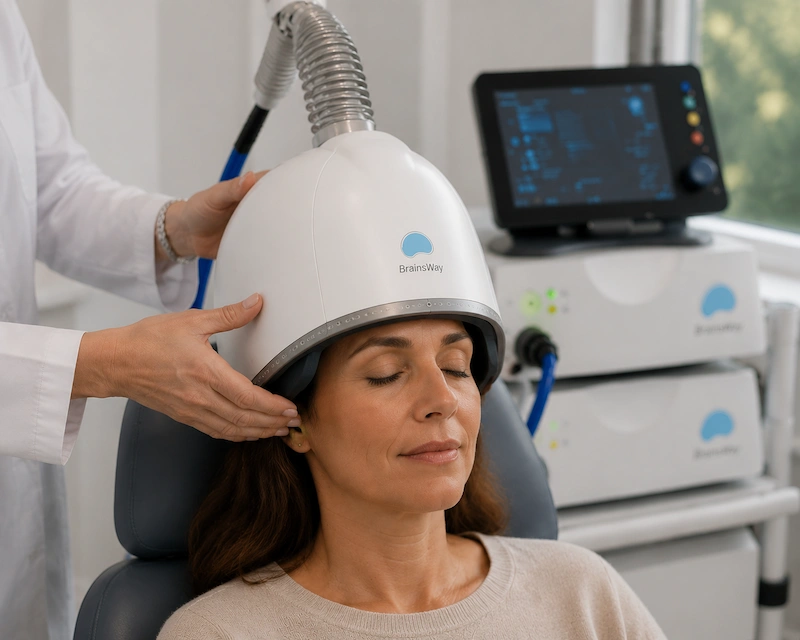
Transcranial Magnetic Stimulation (TMS) is a non-invasive, medication-free treatment that uses magnetic pulses to stimulate specific areas of the brain linked to mood regulation. Unlike medication, it does not travel through your bloodstream, and unlike electroconvulsive therapy, it does not require anesthesia or sedation. You sit in a chair, a coil rests near your scalp, and you can drive yourself home afterward.
This guide breaks down what TMS is, how it works, who it helps, what a session actually feels like, and the risks worth knowing before you book a consultation.
What Is TMS Therapy And How Does It Work?
TMS therapy works by delivering repeated magnetic pulses through a coil placed against the scalp, targeting the prefrontal cortex, the region of the brain most closely tied to mood, motivation, and emotional regulation. These pulses generate small electrical currents that stimulate underactive nerve cells, which in turn appears to ease symptoms of depression and related conditions.
Imaging studies consistently show measurable changes in brain activity after a course of treatment. TMS does not sedate you, alter your memory, or require any recovery time. Most people describe the sensation as a tapping or knocking feeling on the scalp, not pain.
Is TMS The Same As ECT?
No, electroconvulsive therapy (ECT) requires anesthesia and induces a controlled seizure. TMS involves no anesthesia, no seizure, and no memory loss, and patients typically return to work or school the same day.
What Is A TMS Session Actually Like?
A single TMS session typically lasts between 20 and 40 minutes, and a full course usually spans four to six weeks of sessions scheduled five days a week. Here is what the process generally looks like from first visit to final session.
- Initial evaluation. A psychiatric provider reviews your history, current symptoms, and past treatments to confirm TMS is an appropriate fit.
- Motor threshold mapping. During your first session, the provider calibrates the magnetic pulse strength specifically to your brain’s response, ensuring accurate, individualized dosing.
- Daily treatment sessions. You sit in a reclined chair while the coil delivers pulses in a clicking pattern; you remain awake and alert the entire time.
- Progress check-ins. Providers track symptom changes throughout the course using standardized mood scales, adjusting the plan if needed.
- Maintenance planning. After the initial course, some patients benefit from occasional booster sessions to sustain results.
What Conditions Is TMS Used For?
While depression remains the most researched use, TMS is now FDA-cleared for several conditions beyond major depressive disorder, including obsessive-compulsive disorder (OCD) and smoking cessation, with providers also exploring its use for anxiety, PTSD, and ADHD symptoms.
| Condition | FDA Status | Typical Course Length |
| Major Depressive Disorder | FDA-cleared | 4-6 weeks |
| Treatment-resistant depression | FDA-cleared | 4-6 weeks |
| OCD | FDA-cleared | 5-6 weeks |
| Smoking cessation | FDA-cleared | 3 weeks |
| Anxiety, PTSD, ADHD | Used off-label/investigational | Varies by provider |
What Are The Benefits Of TMS Treatment?
People considering TMS usually want to know one thing first: does it actually help when other things haven’t. Here is what the evidence and patient experience point to.
- Non-invasive and drug-free. There is no anesthesia, no medication side effects like weight gain or sexual dysfunction, and no systemic exposure.
- Strong response rates for treatment-resistant depression. Clinical literature reviews report response rates between 50% and 60% for treatment-resistant depression, with remission rates between 30% and 40%, according to a peer-reviewed study in PMC.
- Minimal downtime. Sessions fit around a workday, and patients can drive themselves to and from appointments.
- Well-tolerated side effect profile. The most common side effects are mild headaches or scalp discomfort that typically resolve within hours.
- Insurance coverage has expanded. Many major insurers now cover TMS for treatment-resistant depression when standard criteria are met.
TMS response rates for treatment-resistant depression regularly outperform adding a second medication, without the added side effect burden of another prescription. That single fact is often the deciding factor for people who feel like they have already “tried everything.”
Who Is A Good Candidate For TMS?
TMS is generally considered for adults who have tried at least one antidepressant medication without adequate relief, though every provider evaluates candidacy individually. It is often a strong option for people who:
- Have not responded fully to two or more medication trials
- Cannot tolerate medication side effects
- Are pregnant or nursing and want to avoid systemic medication
- Have a diagnosed OCD or depression condition confirmed by a licensed provider
If you are wondering whether you qualify, our team at Good Health Psych can walk you through eligibility during a TMS therapy consultation, where providers review your treatment history and current symptoms together with you.

What Are The Risks And Limitations Of TMS?
No treatment is risk-free, and honesty about limitations builds more trust than a glossy sales pitch ever will. Here is what matters for someone actually weighing this decision.
- It is not instant. Most people need two to four weeks of daily sessions before noticing meaningful mood changes, which can feel discouraging if you are used to medication’s faster (if less complete) effects.
- It requires a real time commitment. Five sessions a week for a month or more is not realistic for everyone’s work schedule, childcare situation, or transportation access.
- It is not appropriate for everyone. People with certain metal implants, a history of seizures, or specific neurological conditions may not be candidates, and a provider needs to confirm safety first.
- Rare but serious risk of seizure. This occurs in a very small percentage of patients and is one reason sessions are always supervised by trained staff.
- Cost and coverage still vary. Even with expanded insurance coverage, some plans require documented failure of multiple medications first, which can delay access for people who need relief now.
The Bottom Line On TMS
TMS offers something genuinely different from the two paths most people are handed first: keep adjusting medications, or try therapy alone. It gives people with treatment-resistant depression, OCD, and related conditions a non-invasive, evidence-backed option that does not carry the systemic side effects of a daily pill.
If you have spent months or years cycling through medications with limited relief, that is not a personal failure, it is a sign your treatment plan may need a different tool. TMS is one of the more promising tools available today, and the only way to know if it fits your situation is to talk with a provider who can review your history honestly.
Ready to find out if TMS is right for you? Book a free TMS consultation with our team today.
Frequently Asked Questions
What is TMS in simple terms?
TMS, or Transcranial Magnetic Stimulation, is a non-invasive treatment that uses magnetic pulses to stimulate brain regions involved in mood regulation. It is FDA-cleared for depression and OCD and does not require anesthesia or medication.
How long does it take for TMS to work?
Most people notice improvement within two to four weeks of daily sessions, though timelines vary by individual and condition. A full course typically runs four to six weeks.
Is TMS painful?
No. Most patients describe a tapping or knocking sensation on the scalp rather than pain. Mild headache or scalp discomfort afterward is the most common side effect.
Will insurance cover my TMS treatment?
Many insurers now cover TMS for treatment-resistant depression once you have documented an inadequate response to prior medications. Coverage details vary, so it is worth confirming with your provider and insurer before starting.
Can I work or drive after a TMS session?
Yes. TMS does not involve sedation, so patients typically return to normal activities, including driving and working, immediately after each session.
Is TMS the same as ECT?
No. ECT requires anesthesia and induces a controlled seizure, while TMS involves no anesthesia, no seizure, and no memory-related side effects.
Who should not get TMS?
People with certain metal implants near the head, a history of seizures, or specific neurological conditions may not be eligible. A provider evaluation is needed to confirm candidacy before starting treatment.