

According to the CDC’s Autism and Developmental Disabilities Monitoring Network, Centers for Disease Control and Prevention, April 2025, about 1 in 31 children in the United States has been identified with autism spectrum disorder, up from 1 in 36 just two years earlier. For families navigating a new diagnosis, or adults who have carried an autism diagnosis for years, that rising number often comes with a familiar question: what treatment options actually exist beyond behavioral therapy?
This is where TMS for autism enters the conversation, often after a family member spots it while researching options for co-occurring anxiety or depression. TMS, or Transcranial Magnetic Stimulation, is a non-invasive treatment that uses magnetic pulses to stimulate specific areas of the brain, and researchers are actively studying whether it can ease some of the social and behavioral challenges associated with autism.
This article explains what the current research says about TMS and autism, how the treatment works, what benefits and limitations exist today, and how to think about it as part of a broader care plan.
What Is TMS For Autism And How Does It Work?
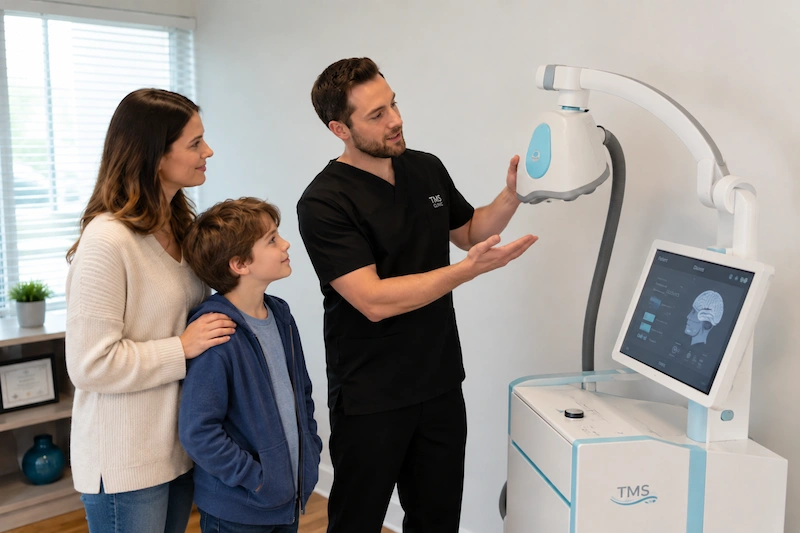
TMS for autism uses the same core technology as TMS for depression and OCD: a magnetic coil placed against the scalp delivers pulses that stimulate targeted brain regions. Researchers studying TMS and autism typically focus on the dorsolateral prefrontal cortex and related areas involved in social processing, attention, and behavioral regulation.
Unlike TMS for depression, which is FDA-cleared and widely available in clinical settings, TMS therapy for autism remains an area of active research rather than a standard, FDA-approved treatment. This distinction matters, since it shapes what families should realistically expect from providers offering it today.
Why Researchers Are Studying TMS And Autism
Autism involves differences in brain connectivity and cortical excitability, particularly in regions tied to social cognition and executive function. A systematic review published in PMC covering studies since 2018 found that TMS interventions showed measurable improvements in stereotyped behavior, repetitive behavior, and verbal social domains across multiple clinical trials. This is why TMS autism treatment has drawn steady research interest despite not yet reaching mainstream clinical use.
What Brain Targets Do Studies Focus On?
Most TMS and autism research targets the bilateral dorsolateral prefrontal cortex, though some newer studies are exploring the parietal lobule and posterior superior temporal sulcus. These regions were chosen because they play a role in social attention, communication processing, and self-regulation, the same domains most affected in autism spectrum disorder. Researchers use different pulse frequencies depending on which symptoms they’re trying to address.
What Does TMS Therapy And Autism Research Currently Show?
Current evidence suggests TMS may help with specific symptom clusters, though it is not considered a cure or a first-line treatment for autism. Here’s what published research points to so far.
- Improvements in repetitive behaviors. Multiple open-label and randomized studies have reported reductions in stereotyped and repetitive behaviors following TMS sessions.
- Gains in executive function. Research suggests low-frequency TMS over the prefrontal cortex may improve self-monitoring and the ability to apply corrective actions during tasks.
- Social and verbal domain changes. Some studies note improvements in verbal social measures, though results vary significantly between individuals and study designs.
- Generally well-tolerated in study settings. Across trials, TMS applied at low frequencies has been reported as safe with manageable side effects.
TMS for autism shows genuine promise in early research, but it has not yet reached the level of evidence that supports FDA clearance the way it has for depression and OCD. Families exploring options for co-occurring conditions may find it helpful to first understand how TMS works for anxiety, since anxiety is common among autistic individuals and TMS is more established there.
Who Might Consider TMS Autism Treatment Today?
TMS for autism is currently accessed mainly through clinical research studies and specialty clinics rather than standard psychiatric practice. It’s worth understanding where things stand before pursuing it.
- Check if you’re a candidate for a clinical trial. Universities and research hospitals, including programs at Yale, continue actively recruiting participants for TMS and autism studies, often for both autistic and neurotypical volunteers for comparison.
- Ask about co-occurring conditions first. Many autistic individuals also experience depression, anxiety, or OCD, and TMS is FDA-cleared for those conditions specifically, which may be a more immediate and evidence-backed option.
- Confirm the provider’s experience with ASD populations. Sensory sensitivities and communication differences common in autism may require adjustments to a standard TMS protocol.
- Discuss realistic expectations. A knowledgeable provider will be upfront that TMS therapy for autism is still investigational rather than promising guaranteed results.
- Review the full treatment picture together. TMS should complement, not replace, established supports like behavioral therapy, occupational therapy, and speech-language services.
If you’re curious whether TMS could help with a co-occurring condition, our team can walk you through eligibility for TMS therapy services during a consultation.
What Are The Risks And Limitations Of TMS For Autism?
Being honest about where the science stands matters more here than almost anywhere else, since families researching autism treatments encounter no shortage of overstated claims online.
| Consideration | What It Means For Families |
| Not FDA-approved for autism | Current use is primarily within research studies, not standard clinical practice |
| Limited long-term data | Most studies involve small samples and short follow-up periods |
| Variable individual response | Improvements reported in research don’t guarantee similar results for every person |
| Sensory considerations | The tapping sensation and clinical environment may require accommodations for autistic patients |
| Access is limited | Few providers outside research settings currently offer TMS specifically for autism |
TMS therapy and autism research is moving forward, but it hasn’t replaced established interventions like applied behavior analysis, speech therapy, or occupational therapy. If your family member also experiences attention or focus challenges, our article on TMS for ADHD covers a related area where evidence is somewhat further along.
The Bottom Line On TMS For Autism
TMS for autism represents a genuinely promising area of research, with early studies showing improvements in repetitive behaviors, executive function, and some social measures. It has not yet reached the point of FDA approval or routine clinical availability the way TMS has for depression and OCD, so it’s important to approach it with realistic expectations rather than as a guaranteed solution.
If you’re exploring options for yourself or a family member on the spectrum, especially where anxiety, depression, or OCD symptoms overlap, an honest conversation with a psychiatric provider is the best starting point.
Curious whether TMS could help with a co-occurring condition? Book a free consultation with our team today.
Frequently Asked Questions
Is TMS approved for treating autism?
No, TMS is not currently FDA-approved specifically for autism spectrum disorder. It is FDA-cleared for depression and OCD, and its use for autism remains primarily within research studies.
Does TMS help with autism symptoms?
Early research suggests TMS may help reduce repetitive behaviors and improve certain executive function and social measures, though results vary between individuals. More large-scale studies are needed before it becomes a standard treatment.
How can I access TMS for autism research studies?
University research centers and specialty clinics occasionally recruit participants for TMS and autism clinical trials. Searching clinicaltrials.gov or contacting academic medical centers is typically the best way to find active studies.
Will TMS help if my child with autism also has anxiety or depression?
Yes, TMS is FDA-cleared for treating depression, and providers may be able to use it for a co-occurring diagnosis even if autism itself isn’t the primary treatment target. A full psychiatric evaluation can clarify the best approach.
What age groups have been studied in TMS and autism research?
Studies span both children and adults, though many recent trials, including major university programs, focus on adults aged 18 to 40. Pediatric research protocols require additional safety considerations.
Are there side effects specific to TMS for autistic individuals?
Reported side effects are generally similar to those in the general population, such as mild scalp discomfort, though sensory sensitivities common in autism may make the experience feel different. Providers experienced with ASD populations can often make helpful accommodations.